Few of you have heard this story, which should have had a better ending. Last time I was in Swaziland, a little white dog, probably less than 10 pounds, turned up at the museum. She was barely alive, covered with the mange. I certainly came close to crying when I saw that the museum staff I worked with had tied her to a pole, left a bowl of water, and just ignored her. No one wanted to touch her. I acted without thinking, grabbing the sweet thing (she was so happy to have attention, she kept trying to lick my face) and headed towards the vet.
By the time I got there and the vet saw her (and gave her a shot of some sort to stop her itching) I was in tears. Then I made my way over to Swaziland's only animal rescue facility and left her there for a special shampooing and potential adoption. The next day I picked her up and brought her with me to the museum. What a cutie pie -- but so tiny, I thought I would step on her little bones and crush her flat. She was looking much better -- all the junk cleared out of her eyes (she could hardly see the day before and one eye was glued shut). Sure enough, one of my co-workers expressed interest in having her, as she liked small dogs and had two already.
I had already spoken to the rescue people about me bringing her to the USA, and they thought I would be able to without a long quaratine. But, I didn't follow up, and when this "parent" presented herself, I said o.k. -- with the caveat that Pinky (her skin was so pink under that white fur) would have a bed all her own on the porch (Swazis do not let dogs in the house. Period).
So, when I got back the other day, I asked my co-worker, how is Pinky Tuscadero? And, in a typical Swazi way, she said, well, Pinly didn't realize that "playing" with snakes was bad. Pinky was bit and died.
I always regretted that I didn't try to take Pinky home with me. I was worried about customs, having her on a 15-hour flight, etc. But, boy, I really should have. She was tiny enough to put in my handbag. RIP Pinky.
Monday, February 15, 2010

Sunday, February 14, 2010

A plethora of pap! Friday was the opening of Parliament (which is right next door to the museum). Many Swazis attended in traditional dress (because the King and Queen Mother were in attendance, much like the Queen of England oversees the opening of Parliament in London with a speech). Though I saw a bit of the goings-on inside on TV, I was more interested in the number of cooking pots of pap, which everyone would eat after the assembly.
Swaziland is said to be in trouble, now that the economic global crisis has filtered down to this small country. The government depends on monies from South Africa given through a special tax. Because South Africa is not getting enough money from this visitor's tax, Swaziland's government has had to slash many departments.
Summer Swazi Landscape
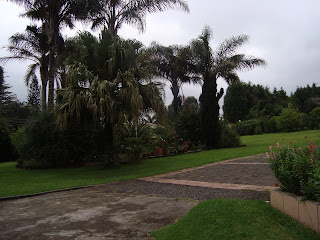


It's summertime in Swaziland, and baby, it's hot outside!
Because the weather is hot and humid, rainfall is common, and therefore grasses are green, and flowers are in bloom.
The picture of the driveway and shrubs is the frontyard of the Kayyam's house, where we live. The flower pics are just things I've seen while driving along.


Wednesday, January 13, 2010
Humans Studying Humans

Hi All. My name is James Macaluso and I am a physical anthropologist (and Laura’s younger brother) who will be joining the team in Swaziland this year.
For those of you unfamiliar with the term, “anthropology” is derived from the Greek words anthrōpos (“human”) and –logia (“study”). Therefore, simply put, anthropology is the science of humankind.
As the focus of anthropology is very broad it is divided into several specialized fields of research. Cultural anthropologists study all aspects of human behavior in contemporary (or living) societies, including marriage customs, subsistence patterns, political organization, ethnicity, art, religion, music, technology, and language. Archaeologists (made famous by the fictional exploits of Indiana Jones) reconstruct, describe, and interpret past human behavior through the study of material remains called artifacts (such as pottery, tools, or food remains).
Although archaeologists are best known for studying prehistory (or the period before the invention of writing), historical archaeologists examine the evidence of later, more complex civilizations that produced written records, including living peoples.
The last subfield of anthropology, and which is my area of expertise, is biological (or physical) anthropology. This field of study is concerned with the non-cultural aspects of humankind. Non-cultural refers to all of those biological characteristics that are genetically inherited from parent to offspring in contrast to those that are learned. Some biological anthropologists are interested in understanding human variation (or the way in which people differ physically throughout the world) and human adaptation (or how people adjust to different environmental stresses, such as living at high altitudes or in environments that have extreme temperatures). Other physical anthropologists study the fossil record of early humans or our primate relatives (monkeys and apes, such as chimpanzees) in order to understand our evolutionary history—or how our ancestors changed through time to become what we are today. Central to physical anthropology is the study of the human skeleton (bones and teeth).
In future posts I hope to provide a little information concerning the scientific research I will be conducting at the National Museum while in Swaziland. I also look forward to your questions and comments about my research and other interesting facts concerning the natural history of Swaziland and its people.
Sunday, January 10, 2010
Wild bird rehabilitation center at Mololotja


 Twana, Kusa and I went up to Mololotja to see the beginnings of a wild bird rehabilitation center that Australian Nikki and her English boyfriend Jason were hired to create. They had a few falcons and owls and were making progress on helping these injured birds get back to flight status. Unfortunately, they did not get the support they needed from the park, and their year of work was for naught. A sad story indeed. Oh, yes, that is a locust you see in the first pic. I saw red, yellow and greens ones. A bit scary if you think about them in hoards.
Swazi snack food


 My dear friend Twana prepared this snack for her family, and I just happened to visit. Her daughter was sitting on the couch, eating these flying insects (that taste a little like eggs -- thanks to the eggs in their little bodies). I put one in my mouth and ran around the room screaming. Her son Kusa, looked at me like was an idiot. I was. This snack food is gathered after a rain, when the insects lose their ability to fly. They are gathered, dried, you pull off the wings and pop them into your mouth.
Subscribe to:
Posts (Atom)


