Friday, February 19, 2010
Why Study Bones?
The study of human bones and teeth is very important to physical anthropology. There are three main areas of research in which knowledge of the human skeleton is often applied.
The first is forensic anthropology, recently popularized by TV shows such as Bones and CSI: Crime Scene Investigation. Forensic anthropologists use scientific methods developed in physical anthropology to aid law enforcement officials in legal or crminal investigations. Experts in this field examine human bones and teeth with the goal of extracting as much information as possible about recently deceased (dead) personsand about the circumstances surrounding their deaths.
The other two research areas in which knowledge of the human skeleton is commonly applied are historical (or relate to the past). Paleoanthropology ("paleo" refers to something old) is the study of ancient humans from fossilized bones and teeth. Researchers in this field are interested in determining who our ancestors were and then, how, and why they evolved. Bioarchaeologists, on the other hand, study human skeletal remains from the more recent archaeological sites. This may include 3,000 year old mummies from Ancient Egypt or human bones recovered from Aztec cities in Mexico dating to only a few hundred years ago. It also includes the skeletal remains that I will be studying while in Swaziland (more to come!).
Because the bones and teeth of the skeleton do not decompose as easily as the soft tissues (such as skin and muscle) they provide the most lasting record of an indvidual's existence. It is possible to estaimate an indvidual's age, sex, ancestry (or "race") and stature (or height) from their bones and teeth. It is also sometimes possible to identify diseases or injuries (such as broken bones) an indvidual may have suffered in life. Skeletal evidence also has the potential to provide information on prehistoric cultural behaviors, such as burial customs and diet.
Having fun at Mantenga Cultural Village
Monday, February 15, 2010
RIP Pinky Tuscadero
Few of you have heard this story, which should have had a better ending. Last time I was in Swaziland, a little white dog, probably less than 10 pounds, turned up at the museum. She was barely alive, covered with the mange. I certainly came close to crying when I saw that the museum staff I worked with had tied her to a pole, left a bowl of water, and just ignored her. No one wanted to touch her. I acted without thinking, grabbing the sweet thing (she was so happy to have attention, she kept trying to lick my face) and headed towards the vet.
By the time I got there and the vet saw her (and gave her a shot of some sort to stop her itching) I was in tears. Then I made my way over to Swaziland's only animal rescue facility and left her there for a special shampooing and potential adoption. The next day I picked her up and brought her with me to the museum. What a cutie pie -- but so tiny, I thought I would step on her little bones and crush her flat. She was looking much better -- all the junk cleared out of her eyes (she could hardly see the day before and one eye was glued shut). Sure enough, one of my co-workers expressed interest in having her, as she liked small dogs and had two already.
I had already spoken to the rescue people about me bringing her to the USA, and they thought I would be able to without a long quaratine. But, I didn't follow up, and when this "parent" presented herself, I said o.k. -- with the caveat that Pinky (her skin was so pink under that white fur) would have a bed all her own on the porch (Swazis do not let dogs in the house. Period).
So, when I got back the other day, I asked my co-worker, how is Pinky Tuscadero? And, in a typical Swazi way, she said, well, Pinly didn't realize that "playing" with snakes was bad. Pinky was bit and died.
I always regretted that I didn't try to take Pinky home with me. I was worried about customs, having her on a 15-hour flight, etc. But, boy, I really should have. She was tiny enough to put in my handbag. RIP Pinky.
Sunday, February 14, 2010
A plethora of pap! Friday was the opening of Parliament (which is right next door to the museum). Many Swazis attended in traditional dress (because the King and Queen Mother were in attendance, much like the Queen of England oversees the opening of Parliament in London with a speech). Though I saw a bit of the goings-on inside on TV, I was more interested in the number of cooking pots of pap, which everyone would eat after the assembly.
Swaziland is said to be in trouble, now that the economic global crisis has filtered down to this small country. The government depends on monies from South Africa given through a special tax. Because South Africa is not getting enough money from this visitor's tax, Swaziland's government has had to slash many departments.
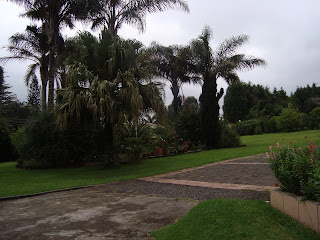
Summer Swazi Landscape
It's summertime in Swaziland, and baby, it's hot outside!
Because the weather is hot and humid, rainfall is common, and therefore grasses are green, and flowers are in bloom.
The picture of the driveway and shrubs is the frontyard of the Kayyam's house, where we live. The flower pics are just things I've seen while driving along.
Subscribe to:
Posts (Atom)